How an Unstable Cartoning Machine Can Cost You $30,000–$80,000 a Year
Alyssa/ December 27, 2025 Return
Most factories never calculate this number.
Not because the loss is small, but because it happens quietly.
No major breakdown.
No alarms.
Just small stops, carton jams, and operators stepping in to keep the cartoning machine running.
By the end of the year, those small interruptions often turn into $30,000–$80,000 in hidden losses.
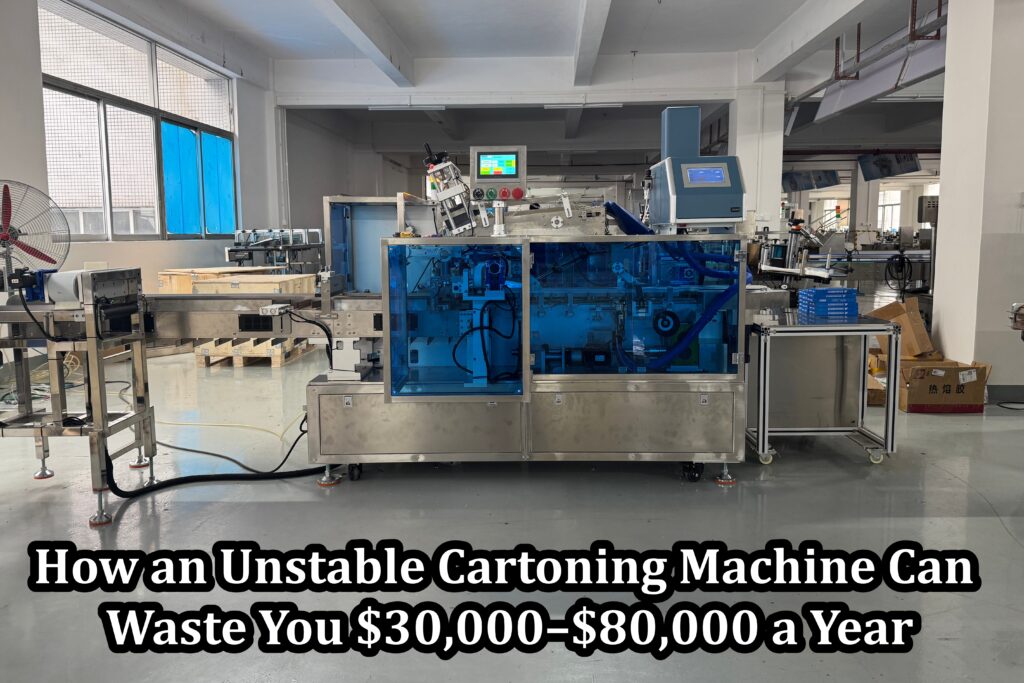
Where the Real Loss Comes From in a Cartoning Machine
It’s not one big failure, but constant small interruptions
An unstable cartoning machine rarely shuts down a packaging line completely.
Instead, it interrupts production again and again.
A carton jams.
A product shifts during loading.
An operator stops the machine, fixes it, and restarts.
Each stop feels minor.
But when this happens dozens of times a day, production time quietly disappears.
This is how cartoning instability drains output without being noticed.
How 1–2 Lost Hours per Day Turn Into $30,000–$80,000 a Year
The math most factories never sit down to calculate
If your cartoning machine causes the line to lose just 1 hour per day,
that adds up to roughly 250 production hours per year.
For many factories, that equals several full production weeks.
Now add the real costs behind those lost hours.
Reduced daily output.
Overtime to catch up.
Extra operators assigned to watch the cartoning machine.
Delayed or rushed shipments.
Without any major breakdown, annual losses easily reach $30,000–$80,000, simply because the cartoning machine cannot run stably.
Have you ever felt busy every day, yet still struggled to hit output targets?
Why Cartoning Machine Instability Hurts More Than Low Speed
Slow but stable can be planned. Unstable cannot.
A slow but stable cartoning machine allows production planning.
An unstable cartoning machine destroys predictability.
Daily targets become estimates.
Schedules slip.
Production managers stop trusting the real capacity of the line.
Instead of improving efficiency, teams spend their time reacting to problems at the cartoning stage.
That loss of control often costs more than downtime itself.
The First Cost You Notice Is Always Labor
When a cartoning machine is unstable, people are pulled in to compensate
When cartoning becomes unreliable, the response is almost always the same.
Add an operator.
Assign someone to watch the end of the line.
Increase overtime.
It feels like a labor problem.
But in reality, it is a cartoning machine stability problem paid for with human effort.
How long can a packaging line rely on people to fix what the machine should handle?
The Cartoning Machine Sets the Lower Limit of Your Packaging Line
Everything upstream eventually waits for cartoning
No matter how fast upstream processes become,
the entire line can only move as fast as the cartoning machine allows.
If the cartoning machine slows down, upstream equipment must slow down.
If it stops, the whole line waits.
This is why cartoning machine stability does not only affect the final step.
It controls the true throughput of the entire packaging line.
Many factories invest heavily in upstream automation, yet see little improvement in total output.
The reason is often simple.
The cartoning machine was never truly stable.
Why Most Factories Discover the Cost Too Late
Low volume hides cartoning instability
At low production volumes, instability is easy to ignore.
Operators correct issues manually.
Small stops don’t feel urgent.
As volume increases, those same issues multiply.
Downtime becomes frequent.
Delivery schedules become fragile.
By the time management recognizes the pattern, the losses are already built into daily operations.
Many factories eventually realize that fixing people does not fix the problem.
Fixing schedules does not fix the problem.
The only real solution is stabilizing the cartoning stage itself.
This is exactly why more manufacturers start re-evaluating their cartoning machines when output no longer grows with effort.
We build cartoning machines for one reason only.
To run stably in real production environments, not just in demos.
If your packaging line feels busy but never productive enough,
the issue may not be your team or your orders.
Think about it.
Is your cartoning machine truly supporting production,
or is it quietly consuming hours of capacity every single day?
If you want, you can share your product type, daily output, or the cartoning issues you face right now.
Many production problems already have their answer at the cartoning stage.
| Keyword | Search Intent | Relevance |
|---|---|---|
| cartoning machine | Commercial | Core Product |
| automatic cartoning machine | Commercial | Product Type |
| cartoning machine downtime | Problem-based | Pain Point |
| cartoning machine stability | Informational | Core Demand |
| secondary packaging machine | Commercial | Application |
| food cartoning machine | Commercial | Industry |
| production downtime cost | Informational | Loss Calculation |
Trending now