Inconsistent Cartoning Makes It Harder to Win New Food Customers
Alyssa/ January 8, 2026 Return
For food brands trying to grow,
getting a new customer is never easy.
Samples are sent.
Meetings are held.
Specifications are discussed.
But in many cases,
the real judgment happens much earlier.
When the first cartons are opened.Get A Quote
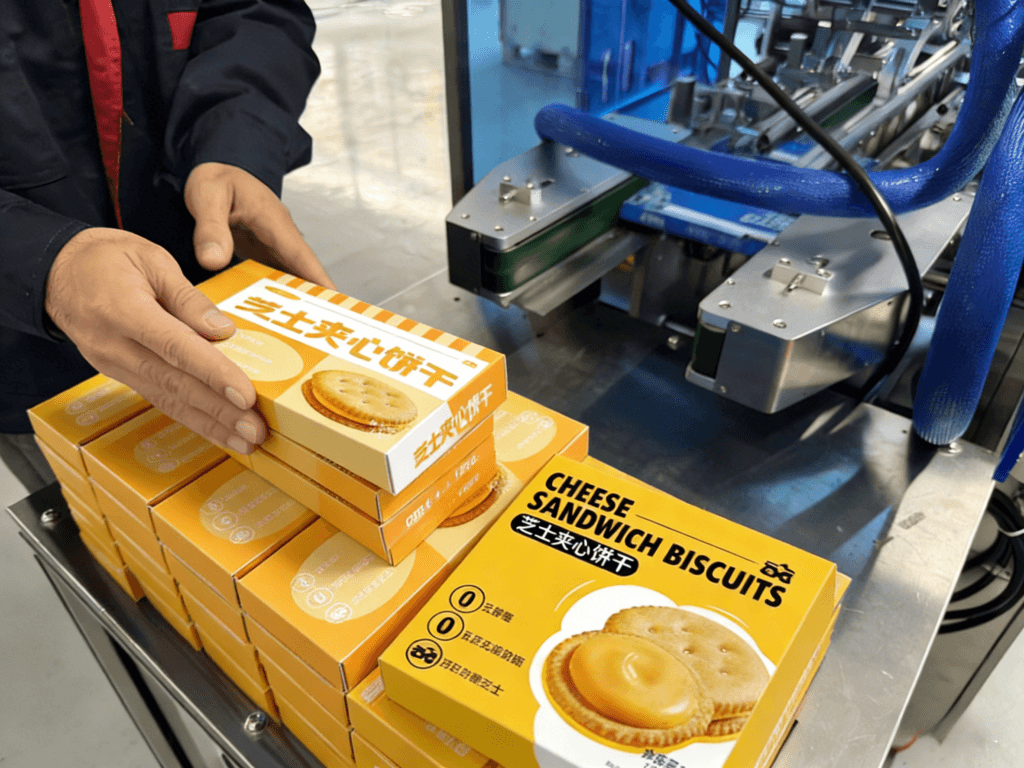
Why First Impressions Matter More in New Business
For biscuit and snack brands,
new customers often see your product only once at the beginning.
That first shipment becomes the reference.
They look at:
- Box shape and finish
- Product placement inside
- Overall neatness and consistency
Before taste or pricing is discussed in detail,
a silent question is already forming:
“Is this supplier stable?”Get A Quote
Where Manual Cartoning Creates Doubt at the Start
Manual cartoning takes place during secondary packaging,
after individual packs are already sealed.
At low volume,
results may look acceptable.
But as soon as quantities increase,
variation appears.Get A Quote
Samples look better than real shipments
Many factories experience this:
- Sample cartons look neat
- First small batch looks fine
- Larger batches look different
From the customer’s perspective,
this raises concern.Get A Quote
Packaging looks inconsistent across boxes
When cartons vary:
- Product position shifts
- Boxes feel uneven
- Visual quality changes slightly
None of these are “defects”,
but together they weaken confidence.Get A Quote
Why New Customers Are Sensitive to These Signals
New customers do not know your process yet.
They cannot see:
- Your quality system
- Your internal controls
- Your intentions
They only see results.
When packaging looks inconsistent,
they assume:
“If this changes now,
what will happen when volume grows?”Get A Quote
Why Manual Control Is Not Enough in This Stage
Most factories try to reassure new customers by:
- Explaining processes
- Promising tighter checks
- Sending revised samples
These actions help temporarily.
But the underlying issue remains:
Manual cartoning produces variation that is hard to explain away.
And explanations rarely build trust
as well as visible consistency.Get A Quote
How a Cartoning Machine Helps Build Early Trust
Here we are talking about secondary packaging —
cartoning after individual packs,
with no direct contact with food.
This is where consistency can be locked in.Get A Quote
Samples match mass production
- Same structure
- Same appearance
- Same presentation
What customers see at the beginning
is what they continue to receive.Get A Quote
Packaging becomes a proof of stability
- Less explanation needed
- Fewer follow-up questions
- Stronger confidence in scaling
Negotiations become smoother
When packaging looks controlled:
- Focus shifts to volume and price
- Discussions move faster
- Decisions are easier
This is not about impressing customers.
It is about removing doubt at the earliest stage.Get A Quote
A Question Worth Asking
When a new customer receives your first real shipment,
does it look exactly like the samples you showed?
Or does it quietly introduce questions
you now have to explain?
For many food brands,
standardizing cartoning is not just a production decision —
it is a business development advantage.Get A Quote
| Industry | Business Stage | Customer Scenario | Main Risk | Solution Keyword |
|---|---|---|---|---|
| Food | Brand Expansion | New customer first orders | Packaging inconsistency reduces trust | Automatic Cartoning Machine |
Trending now