Why 3C Electronics Factories Are Switching to Automatic Cartoning Machines in 2025
Alyssa/ December 6, 2025 Return
The Hidden Packaging Pressure in Modern Electronics Production
Walk into any 3C electronics factory today—whether it produces phone chargers, earbuds, smartwatches, USB hubs, gaming accessories, or mini home devices—and you will quickly notice one thing:
The packaging area is always the most chaotic part of the entire line.
Workers fold boxes by hand, insert products carefully, close flaps with different levels of force, and try not to scratch the item. Even highly trained workers struggle to maintain accuracy over long shifts.
At first glance, manual cartoning looks simple.
But in electronics manufacturing, it has become the largest hidden bottleneck affecting speed, quality, customer satisfaction, and even long-term brand image.
Why Manual Cartoning Fails in Electronics Factories
Too Many SKUs, Too Many Size Changes
3C factories rarely run a single product size. In a single day they may package:
- slim phone cases
- thick power banks
- soft earbuds
- rigid chargers
- delicate screen protectors
Every size change slows down folding speed and increases errors.
Manual teams cannot maintain the same level of consistency across dozens of sizes.
Electronics Are Extremely Scratch-Sensitive
Even a small scratch on plastic, aluminum, or glossy coating can ruin the product.
Manual insertion increases the chance of:
- surface scratches
- cracked corners
- bent cables
- fingerprint contamination
- pressure marks
Every scratched product becomes either a rework or a return—and both are expensive.
Electronics customers judge harshly. A small scratch equals a lost customer.
Slow, Unstable Folding Speed
Workers vary wildly in speed:
- One folds 300 boxes/hr
- One folds 180
- One loses focus
- One gets tired after 2 hours
This creates a constant stop-and-go effect across the entire line.
High Turnover and Continuous Retraining
Packaging work is repetitive and physically tiring.
Workers quit frequently, especially during busy seasons.
This forces supervisors to repeatedly train new workers…
…who often leave before they become skillful.
Peak Seasons Turn Into Chaos
During sales events and holiday promotions, electronics factories experience sudden order spikes.
Manual teams cannot scale fast enough.
Factories end up:
- missing deadlines
- pushing overtime
- paying high temporary labor rates
- sacrificing quality to meet speed
All of this increases cost and reduces profit margins.
Why Automatic Cartoning Machines Are the Perfect Fit for 3C Factories
Stable Output at 720–900 Boxes Per Hour
A machine does not slow down.
It does not get tired.
It does not vary between morning and night shifts.
It simply produces 720–900 perfectly folded boxes every hour, all day long.
Uniform Folding Creates a Professional Brand Image
Machines fold boxes with:
- identical angles
- identical lock tightness
- clean edges
- secure structure
This consistency makes products look premium—critical for consumer electronics.
Scratch-Free Product Handling
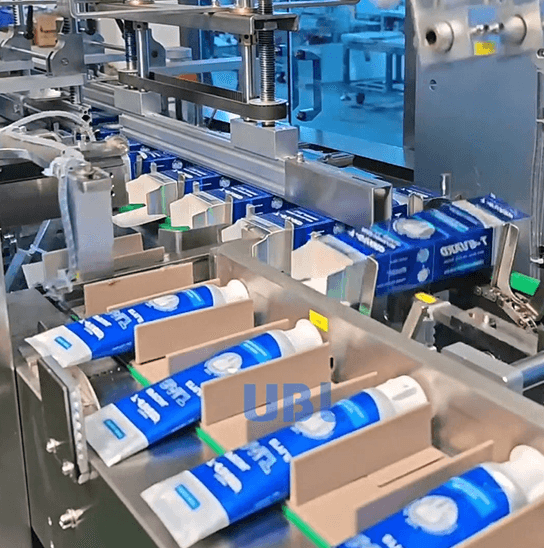
UBL and other advanced systems use controlled insertion paths to prevent:
- friction
- impact
- bending
- scraping
This dramatically reduces returns and customer complaints.
Fast SKU Changeover
A major electronics pain point is switching between dozens of sizes.
A good cartoning machine switches sizes in minutes, not hours.
This alone improves daily output.
Reduces 2–4 Workers Per Line
With fewer people touching products:
- errors decrease
- damage decreases
- cost decreases
- quality increases
This is one of the fastest ROI points for electronics factories.
Before and After Automation in a Real 3C Factory
Before Automation
- Boxes folded by hand
- Workers inserting products manually
- Frequent scratches
- Random orientation errors
- Endless rework
- Supervisors firefighting all day
After Automation
- Perfectly folded boxes
- Controlled, scratch-free insertion
- 720–900 boxes/hr
- Reduced labor
- Stable peak-season performance
- Workers supervise instead of suffering
The packaging area becomes predictable, calm, and highly efficient.
Why Many 3C Factories Choose UBL (Subtle Promotion)
UBL’s cartoning machines are widely used in electronics plants because they provide:
- scratch-free handling systems
- 720–900 pcs/h true speed
- fast size switching
- precise electronic positioning
- 24/7 stability
- low maintenance
- compatibility with sealing, labeling, and boxing lines
Factories like UBL because their machines do not cause trouble—and that reliability creates profit.
Automation Is Now a Requirement, Not an Option
3C product consumers expect:
- flawless packaging
- no scratches
- safe handling
- premium unboxing experience
Manual packing simply cannot keep up.
Automatic cartoning machines deliver:
- higher speed
- higher quality
- lower labor cost
- stronger brand trust
- fewer returns
- more efficient workflows
In 2025, automation in electronics packaging is survival—not luxury.
| Issue | Cause | Impact on Production | Recommended Maintenance | Related Equipment (UBL) |
|---|---|---|---|---|
| Scratches on electronics | Inconsistent manual insertion | High returns, customer complaints | Shift to automated non-scratch insertion | UBL Anti-Scratch Cartoning Machine |
| Bottlenecks in packaging | Worker fatigue and slow manual folding | Delayed shipping, overtime costs | Use high-speed automated folding | UBL High-Speed Cartoner |
| Incorrect product orientation | Human placement errors | Rework, jammed packaging | Use guided machine positioning | UBL Precision Positioning Module |
| SKU changeover delays | Manual size adjustments | Long downtime | Use fast-changeover system | UBL Multi-SKU Cartoning Line |
| High labor cost | Large manual packing workforce | Reduced profit margins | Automate folding & loading | UBL Smart Packaging Line |
Trending now