Why Snack Brands Lose Money in the Final 10 Seconds of Production
Alyssa/ December 3, 2025 Return
The Hidden Breakdown Point No Snack Factory Talks About
Why the Cartoning Stage Fails When Orders Surge
Have you ever noticed how snack factories—protein bars, granola squares, mini cookies, small pouches—run perfectly until the very last ten seconds of production? Mixing is smooth. Baking is smooth. Cooling is stable. Wrapping is fast. But once the products reach the cartoning stage, the entire production line slows down like hitting a concrete wall.
If you operate a snack brand or a fast-moving food factory, you’ve likely stood in front of the packaging table thinking:
“How can the smallest step create the biggest disaster?”
Because snack products are fragile.
Because cartons slip.
Because workers get tired.
Because boxing looks simple—but it is the most unstable part of the entire line.
What Actually Happens at the Boxing Station
Imagine the scene:
Workers try to fold thousands of glossy boxes, but the coating is too slippery.
Protein bars bend, crack, or shift inside the wrapper.
Mini cookies crumble when pressed.
Boxes don’t close clearly.
Corners collapse.
Structure becomes soft.
QC rejects whole stacks.
Warehouse keeps asking: “When will the cartons arrive?”
Customer service panics because yesterday’s orders were delayed.
You can feel the pressure building.
This is where most food brands lose money—in the final 10 seconds.
The Core Problem Behind Snack Cartoning Failure
Why Manual Boxing Cannot Handle Fragile Food Products
Manual boxing was never designed for:
- Soft bars
- Easily crushed cookies
- Slippery pouches
- Laminated cartons
- Fast-changing SKU sizes
- High e-commerce demand
Human folding is inconsistent.
Human handling pressure varies.
Human fatigue ruins structural accuracy.
And customers always notice packaging failures.
A dented box → “Cheap product”
A soft box → “Melted or damaged”
A wrinkled carton → “Not safe to eat”
In the snack category, the box is the first impression.
How Poor Box Quality Damages Your Brand
When boxing fails:
- Bars break inside the box
- Cartons collapse during shipping
- Retailers reject weak packaging
- E-commerce buyers complain
- Return rate increases
- Product photos look unprofessional
All because the last step wasn’t stable.
How UBL Cartoning Machines Solve Snack Packaging Problems
Consistent Box Forming for Laminated and Glossy Cartons
UBL forms every box with:
- Sharp creases
- Strong structure
- Perfect alignment
- Consistent folding pressure
No soft corners.
No collapsing panels.
No slipping.
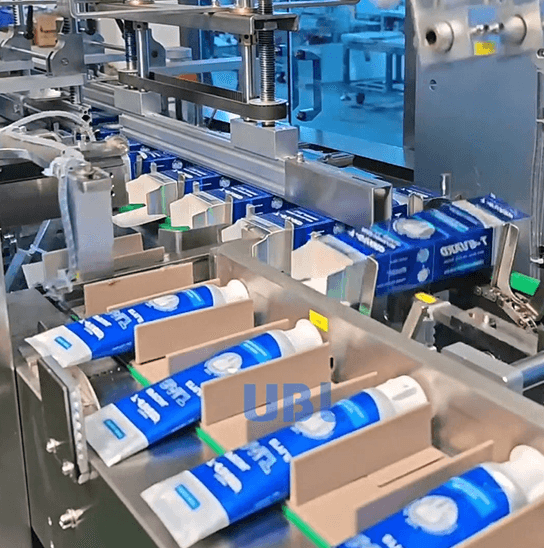
Gentle Product Loading for Fragile Bars and Cookies
Inside the machine:
- Bars are guided smoothly
- Cookies are protected from pressure
- Pouches enter without bending
- Products remain intact and visually perfect
UBL protects the product and the box.
High-Speed Output for E-Commerce & Retail Packaging
UBL ensures:
- Fast format change
- Stable high-speed boxing
- No human fatigue
- No inconsistencies
Factories report cutting boxing time by 40–60%.
What Snack Brands Experience After Automation
Instant Improvements in Product Stability and Brand Image
Factories that adopt UBL report:
- Stronger boxes
- Fewer product breakages
- Smoother production flow
- Better e-commerce unboxing experience
- Lower QC rejection rates
- On-time shipping even during peak season
Automation doesn’t just increase speed—
it protects your brand reputation.
Final Thoughts — Is Your Boxing Area Hurting Your Snack Brand?
Ask Yourself Before the Next Big Order
Is your boxing area:
- Slow during peak orders?
- Causing bars or cookies to break?
- Producing soft or weak boxes?
- Creating QC headaches?
- Delaying e-commerce shipments?
- Making your brand look cheap?
If yes, then the product isn’t the problem—
the box is.
And UBL is built to fix exactly that.
Tell me what snacks you package—protein bars, mini cookies, granola bites—and I’ll recommend a UBL cartoning solution tailored to your line.
| Issue | Cause | Impact on Production | Recommended Solution | Related Equipment (UBL) |
|---|---|---|---|---|
| Boxes collapsing during forming | Insufficient forming pressure or weak carton material | Soft boxes, poor retail appearance, QC rejection | Increase forming force, adjust folding guides, verify carton thickness | UBL Automatic Cartoning Machine |
| Protein bars bending or breaking | Excessive manual pressure during loading | Damaged product, customer complaints, returns | Use automated gentle-loading unit to reduce product stress | UBL Product Loading System |
| Pouches slipping during boxing | Glossy or laminated surface reduces friction | Misaligned loading, slowed cycle, inconsistent carton fit | Upgrade transport belts, optimize vacuum gripping | UBL High-Friction Carton Transport Module |
| Boxes not fully closing | Incorrect tuck-flap angle or poor carton lock design | Open cartons, damage during shipping, retailer rejection | Adjust tuck mechanism, verify flap design | UBL Tuck-in Closing Unit |
| Slow boxing speed during peak orders | Manual handling limitations, worker fatigue | Delayed shipments, overtime labor, missed deadlines | Increase automation, optimize load distribution | UBL High-Speed Cartoning System |
Trending now